Organic Crib Mattresses · Practical Guide
Choosing a Naturepedic Organic Crib Sleep Surface: Fit, Materials, and Care
A crib mattress has a modest job and an exacting one: it should fit the crib, stay firm and flat, and be simple to keep clean. When considering a Naturepedic organic crib mattress, look beyond the word “organic” to the product’s dimensions, construction, instructions, and compatibility with the crib. Those details—not a lengthy list of features—make a useful starting point for a safe, practical nursery.
Choosing a sleep surface for an infant can feel like a decision about everything at once: materials, breathability, cleaning, allergies, longevity, and safety. A clear order of priorities helps. First, establish that the mattress is intended for the crib and fits it securely. Then review firmness, the mattress’s construction, care directions, and any claims about materials or certifications. Comfort features and environmental preferences can matter, but they should not displace the basics.
This guide uses the Naturepedic Ultra Breathable 2-Stage Organic Crib Mattress as a concrete example of the questions a family may want to ask. Product specifications can change, and individual models may differ. Always check the current manufacturer instructions and the labels on the exact product you are considering. For safe-sleep guidance, consult current recommendations from recognized public-health authorities, such as the American Academy of Pediatrics, and follow local requirements.
Start with fit: the mattress belongs inside the crib, not merely near it
A mattress that is too small can leave a gap between its edge and the crib frame. That makes fit a practical safety check, not a matter of appearance. A crib mattress should sit level, lie flat, and fit snugly within the crib without being forced, bowed, or visibly compressed by the frame. The crib and mattress should be used in the combination and manner their manufacturers specify.
“Standard size” is a useful description, but it is not a substitute for measuring. Check the crib’s instructions for its approved mattress dimensions and measure the usable interior if the manufacturer advises doing so. Then compare those requirements with the mattress’s published dimensions. The Naturepedic Ultra Breathable 2-Stage model is listed at approximately 27¼ by 51⅝ inches and 6 inches thick; confirm the current specifications and your crib’s requirements before purchase, since dimensions and model details can vary.
Once the mattress is in place, check the fit around all four sides. It should lie flat and remain stable. Do not try to correct a loose fit with towels, blankets, foam, or homemade fillers. If the mattress and crib are not compatible, contact their manufacturers or choose a compatible mattress. A fitted sheet should be the correct size for the mattress and should stay securely in place; loose fabric is not a solution to a fit problem.
- Confirm that the mattress is intended for the exact type of crib you own.
- Compare the crib’s permitted mattress dimensions with the mattress’s current measurements.
- Check that the surface lies flat and fits closely around the perimeter.
- Follow the crib manufacturer’s directions for mattress height and any adjustable support positions.
- Do not add objects around the mattress to fill gaps or raise its surface.
Fit can also change if a mattress is damaged, warped, or used with a different crib. Recheck it if you move the crib, change its configuration, or notice that the mattress no longer sits securely. The instruction booklets are worth keeping: they explain the intended setup and may identify limits on use or compatible accessories.
Firm and flat is a feature, not a flaw
Adults often associate comfort with a mattress that cushions and contours. For an infant’s sleep surface, that instinct should not set the standard. Current safe-sleep guidance calls for a firm, flat, non-inclined surface made for infant sleep, with the baby placed on their back for every sleep. The mattress should not sag or form a soft hollow under pressure. A plush topper, pillow, quilt, positioner, or other added padding does not belong in the sleep space.
Some crib mattresses are described as “two-stage,” with one side intended for an infant and another for a toddler. The Naturepedic model described here is marketed as a two-stage mattress, with a firmer infant side and a somewhat plusher side for later use. That description should not be treated as permission to use a soft infant surface. Follow the product’s specific instructions for identifying each side and changing the setup, and use a different stage only when the manufacturer says it is appropriate for the child’s age and the crib’s configuration. If the instructions are unclear, ask the manufacturer before changing the mattress orientation.
A baby’s sleep surface should remain free of loose bedding and soft objects. Use only a fitted sheet designed to fit the mattress securely, unless current official guidance or the product’s instructions specify otherwise. Do not add a separate pad or topper to alter the feel. If a mattress includes a particular component as part of its design, verify in the current instructions how that component is to be installed and used; do not improvise by adding, removing, or substituting layers.
What the Naturepedic construction details can tell you
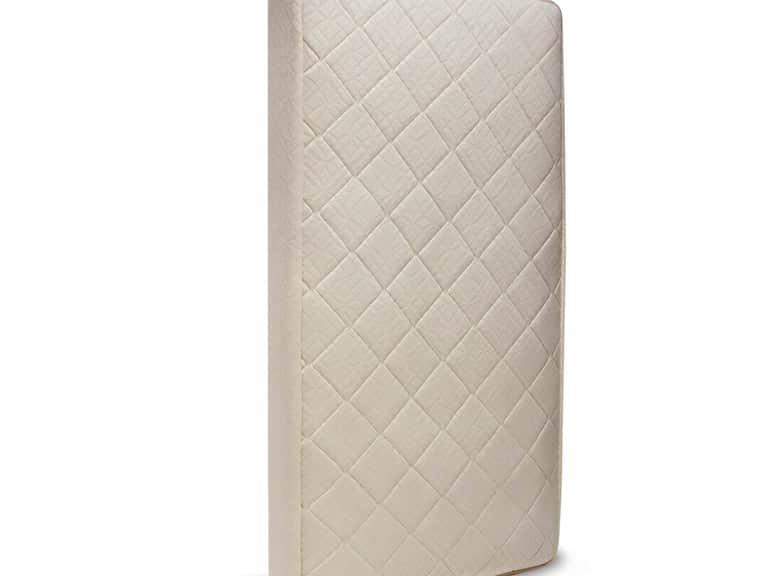
The listed Ultra Breathable 2-Stage model combines a firm, flat support core with a breathable mattress pad described by the manufacturer as part of the product. Its listing also describes a waterproof outer surface designed to be wiped clean, a lightweight version weighing about 12.5 pounds, and an innerspring version with 144 coils. The product page identifies organic cotton and a polyethylene waterproof surface, and states that the mattress is made without wool, latex, or soy. Verify each detail against the exact model and current product documentation.
These features answer practical questions, but they do not all mean the same thing. A waterproof surface may make cleanup easier, for example, while a washable cover or pad may require a different routine. “Breathable” is a product description, not a reason to change safe-sleep practices or add extra bedding. No feature should be understood as eliminating the need for a firm, flat surface, an appropriate fit, and an uncluttered crib.
Materials are best assessed layer by layer. Ask what is used in the core, cover, waterproof barrier, seams, and any included pad. Find out which parts can be removed, washed, or replaced, and which must remain installed during use. If a child has a diagnosed allergy or sensitivity, discuss the specific materials with a qualified health professional and verify the complete material list with the manufacturer. Broad claims about “natural,” “hypoallergenic,” or “chemical-free” do not replace product-specific information or medical advice.
Questions about materials
- What materials are used in the core and surface layers?
- Is the waterproof layer integral to the mattress or a separate accessory?
- Does the model contain materials a family needs to avoid?
- Which parts are included, and how are they intended to be used?
Questions about everyday use
- Can the surface be wiped clean, and with what?
- Is any cover removable or machine washable?
- How should the mattress be dried after cleaning?
- What are the limits on rotating or flipping the mattress?
Understanding organic claims and certifications
“Organic” can refer to a particular material or to a defined portion of a product, rather than every component in a finished mattress. Certification can help clarify which materials or stages of production were assessed, but the name of a certification alone does not explain everything a buyer may want to know. Read the scope of the claim and look for current documentation that identifies the product, the certified material, and the standard involved.
The Naturepedic listing identifies organic cotton and describes the mattress as GOTS-certified. Before relying on a certification, check the current product label or documentation and confirm what the certification covers. A certification for textile fibers, for instance, should not automatically be read as a certification of every component or as proof that a product meets every possible health, safety, or environmental preference. Ask the manufacturer for clarification where the scope is not clear.
Keep separate three questions that can become tangled in marketing language: Is the mattress designed and labeled for use in the intended crib? Does it meet applicable safety requirements? And do its materials and manufacturing practices align with a family’s preferences? An answer to one does not automatically settle the others. Regulatory compliance and safe use should be confirmed through current product labeling and authoritative guidance rather than inferred from terms such as “organic” or “green.”
Care instructions: clean carefully, preserve the construction
Crib mattress care is model-specific. A surface that is described as waterproof and wipe-clean is not necessarily machine washable, and an included pad may have its own separate instructions. Before the first use, read the care label and the manufacturer’s guidance for the mattress and every included component. Keep those directions accessible; guessing at detergent, heat, soaking, or drying can damage materials or affect how they fit.
For a wipe-clean surface, use only a cleaning method approved by the manufacturer. Avoid soaking the mattress, using unapproved solvents or disinfectants, or applying strong chemicals simply because they are common household products. If a removable component is washable, follow its stated water temperature, detergent, and drying instructions. Let anything that has been cleaned dry fully as directed before it is returned to the crib. Do not put a damp mattress or cover back into use.
Prompt cleanup matters because moisture trapped within bedding can create hygiene problems and may damage materials. If liquid reaches a seam, edge, or interior layer, consult the manufacturer rather than assuming that wiping the top has addressed it. Avoid covering a stain with an extra pad or a loose towel. The sleep space should be prepared in the approved way, with a correctly fitted sheet and no improvised layers.
Inspect the mattress periodically for damage, persistent odor, broken seams, loose parts, warping, or a surface that has become uneven. Stop using it if its condition raises concern, and contact the manufacturer for advice. Do not attempt repairs with tape, adhesive, added foam, or other materials unless the manufacturer explicitly provides an approved repair process. If the product is recalled or its label is missing, seek guidance from the manufacturer and relevant safety authorities before continued use.
A two-stage design and the question of longevity
A mattress marketed for two stages may appeal to families hoping to use one product as a child grows. The practical value depends on the instructions, the child’s development, and the crib’s permitted configuration—not just on the word “convertible.” Identify which side is intended for each stage and when the manufacturer says the transition is appropriate. Use the crib’s own instructions when adjusting mattress-support height, and never place the mattress at a position the crib maker does not allow.
Longevity also depends on condition. A mattress should not be kept in service simply because it has a second side or because the family has not reached a suggested age range. Check that it remains clean, structurally sound, flat, and compatible with the crib. A used mattress should be assessed with particular care: confirm its history if possible, inspect it thoroughly, and verify that it has not been recalled or altered. When its condition or safety cannot be established, ask a qualified source for guidance rather than relying on appearance alone.
Resist the idea that more add-ons necessarily make a better nursery. A well-matched mattress, a fitted sheet, and a clear sleep space are a more useful foundation than a collection of cushions and accessories. If you are considering a protector, pad, or replacement cover, confirm that it is designed for the exact mattress, permitted by its manufacturer, and consistent with current safe-sleep recommendations. Do not use an accessory to change the firmness or fill a gap.
A measured look at the Naturepedic Ultra Breathable 2-Stage
For readers comparing options in the Organic Crib Mattresses category, the Naturepedic Ultra Breathable 2-Stage Organic Crib Mattress is a relevant example because its published details address several common research questions: stated dimensions, a two-stage design, organic cotton, a waterproof outer surface, and care-oriented construction. The listing also describes a breathable pad as part of the product, a lightweight option, and an innerspring construction with 144 coils. These are product specifications, not a substitute for confirming the current model’s instructions and fit.
Before choosing it, compare its exact dimensions with your crib; confirm which components are included and how they should be used; and ask how the mattress, surface, and any pad are cleaned. Check what the manufacturer means by its organic and certification claims, and confirm that the exact model is intended for your planned use. If a description or instruction seems to conflict with current infant safe-sleep recommendations, pause and seek clarification from the manufacturer and a qualified health professional. A marketing phrase should never be used to justify an unsafe sleep setup.
A practical checklist before the nursery is ready
A short checklist can turn a crowded product comparison into a sequence of verifiable steps. Keep the emphasis on compatibility, instructions, and a simple sleep environment:
- Crib compatibility: The mattress is identified as suitable for the crib, and the dimensions match the crib manufacturer’s requirements.
- Secure fit: It sits flat and snugly, with no improvised fillers, added foam, or visible bowing.
- Firmness and surface: The infant sleep surface is firm, flat, and non-inclined, as described in current safe-sleep guidance.
- Components: Every included pad, cover, or layer is accounted for, with clear instructions for installation and use.
- Materials and claims: Product-specific documentation explains the materials and the scope of any certification or organic claim.
- Cleaning: Care directions are available, practical for the household, and understood before a spill occurs.
- Condition: The mattress is free of damage, warping, persistent moisture, or unauthorized alterations.
- Sleep space: The crib remains uncluttered, with no pillows, loose blankets, positioners, or unapproved accessories.
The useful questions are the simplest ones
Organic crib mattresses can differ in materials, construction, weight, and cleaning requirements. Those distinctions may matter to a family, but they are most useful when considered after the essentials. Does the mattress fit the crib? Is the intended infant surface firm and flat? Are the product’s components and instructions clear? Can the family care for it as directed? Can claims about materials and certifications be verified?
The Naturepedic Ultra Breathable 2-Stage offers a specific set of features for shoppers to investigate, including a two-stage design and a described breathable pad. Its suitability depends on the exact model, the crib, and faithful use of the current instructions. In the end, a good nursery decision is not the one with the most impressive language. It is the one whose details can be checked—and whose sleep setup stays simple, secure, and consistent with authoritative safety guidance.